“My Dad Works at the Pentagon.” The Class Laughed—Ten Minutes Later, Everyone Went Silent.
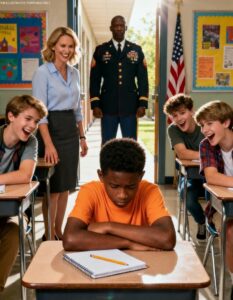
When twelve-year-old Noah Bennett mentioned during social studies, “My dad works at the Pentagon,” the room erupted with laughter.
Mrs. Caldwell paused mid-sentence, chalk in hand, and turned toward him with a mix of patience and skepticism. “Noah,” she said, “this activity is about sharing honest experiences. Let’s be truthful with one another.”
But the laughter only grew. Ryan Blake, the class clown, leaned back in his chair smirking. “Right, and my dad’s the president,” he quipped, sending the class into another fit of giggles.
Noah’s stomach knotted. He stared down at his notebook, wishing he could disappear into the pages. He wasn’t making it up—his father, Colonel Steven Bennett, genuinely worked at the Pentagon—but appearances had a way of overshadowing reality. Worn-out sneakers and a neighborhood that invited whispers had made him a target.
Mrs. Caldwell sighed and returned to her lesson, brushing the incident aside. “Can anyone explain what a civil servant does?”
By the time the bell rang, the teasing had spilled onto the playground. Ryan strutted around with mock military precision. “Clear the way for the Pentagon boy!” he barked, drawing laughter from his friends.
Noah clenched his fists, each laugh cutting deeper than the last. He turned toward the restroom, ready to vanish from the world, when Lucy Ward, one of the quieter students, slipped up beside him. “They shouldn’t say that,” she murmured. “I don’t think you’d lie about
something like that.”
“It doesn’t change anything,” Noah muttered. “They’ve already decided what’s true.”
Then, ten minutes later, everything shifted.
The students lined up after recess, still buzzing with chatter. Suddenly, the hallway went silent. Heavy, deliberate footsteps echoed down the corridor. Heads swiveled as a tall man in a decorated military uniform appeared, medals gleaming, posture rigid with quiet authority.
“I’m here for my son, Noah Bennett,” the man said. His voice was calm but carried unmistakable weight.
The classroom froze. Mrs. Caldwell’s eyes widened. “Colonel Bennett?” she asked.
“Yes,” he said with a polite smile. “Noah mentioned you were discussing government work today. I thought I’d stop by.”
Noah’s mouth went dry. “Dad?” he whispered.
The colonel softened and opened his arms. Noah dashed forward, feeling the gaze of every classmate upon him. In a room full of stunned silence, father and son embraced.
Mrs. Caldwell recovered first. “We’re honored to have you, Colonel Bennett. Perhaps you could share a bit about your work with the students?”
He nodded. “The Pentagon might seem mysterious, but it’s mostly offices filled with people committed to protecting this country. It’s not about rank or prestige—it’s about service.”
Ryan’s jaw dropped. Lucy allowed herself a small smile. Not a single student laughed.
Placing a hand on Noah’s shoulder, the colonel added, “My son spoke the truth today. Sometimes being honest takes more courage than people realize. The truth exists independently of belief.”
Ryan swallowed and murmured, “I’m sorry, Noah. I shouldn’t have made fun of you.”
Noah nodded. “Just don’t call someone a liar until you know the full story.”
By lunchtime, whispers of the encounter had spread like wildfire. Noah entered the cafeteria under a new kind of scrutiny—the boy mocked in the morning now held a quiet, unshakable respect.
Ryan approached, hands stuffed in his pockets. “Hey… I mean it. I was wrong.”
Noah offered a small smile. “It’s fine. Let’s just move on.”
Lucy joined them. “I told everyone you weren’t lying,” she said proudly.
That afternoon, Mrs. Caldwell addressed the class. “I owe you all an apology, particularly to Noah. We let assumptions cloud our judgment. Judging someone based on where they live or how they appear is unfair—and not who we should be.”
Her words hung in the quiet classroom. Even Ryan and his friends seemed chastened.
As the final bell rang, Noah walked home alongside his father. The cool autumn air carried the scent of rain, and streetlights flickered on.
“Thanks for coming today,” Noah said.
His father smiled. “You already did the hardest part—telling the truth. I just reminded everyone that honesty never needs validation.”
Noah kicked a pebble along the sidewalk. “Still… it felt good to see their reactions.”
The colonel chuckled. “It does. But remember, opinions change. Integrity does not.”
Noah nodded, finally feeling pride instead of embarrassment. From that day forward, no one questioned him again. The image of Colonel Bennett in full uniform lingered in the halls of Lincoln Middle School for months—a living testament that truth has its own power, respect begins with listening, and sometimes courage is simply standing firm until others understand.