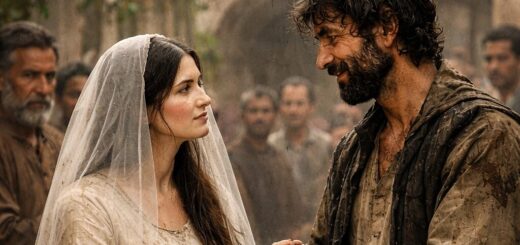
The bride died right during her wedding and was taken to the morgue, but the morgue attendant noticed something strange: the bride’s cheeks were rosy, as if she were alive, and her heart was beating. Then something happened that terrified everyone.
The bride died right during her wedding and was taken to the morgue, but the morgue attendant noticed something strange: the bride’s cheeks were rosy, as if she were alive, and her heart was beating. Then something happened that terrified everyone.
In the morning, an ambulance arrived at the building. The siren suddenly fell silent, and cars decorated with white ribbons and flowers drove into the courtyard. A real wedding procession stopped outside the morgue.
People dressed in festive clothes stood there in confusion. Some were crying, while others simply stared blankly into the distance.
The bride was carried inside on a stretcher. She was wearing a lace wedding dress, and her hair was carefully styled. Her bouquet was still lying on her chest.
The groom walked beside her.
He wasn’t screaming or crying. He looked at her as if everything that was happening had to be some kind of mistake.
The morgue attendant watched from the corridor. She had only recently started working there. At first, she had been frightened. At night, she dreamed about the corridors and cold walls.
Once, the senior doctor told her:
— You shouldn’t be afraid of the dead. The more dangerous ones are those who are alive, walking around and smiling.
From that moment on, she began to feel comfortable around the bodies. They could no longer hurt anyone.
After the relatives were taken away, the body was left in the morgue compartment. The doctor quickly checked the paperwork and said:
— The autopsy will be tomorrow. Finish your shift today and don’t stay late.
— Has the cause of death been confirmed? — the attendant asked.
— Poisoning. Everything is clear and signed. Don’t worry.
He left.
The room became quiet.
The attendant remained alone.
She walked closer to the table.
The bride looked too peaceful.
Her skin wasn’t gray. Her lips weren’t blue.
Her cheeks seemed to have a faint rosy glow.
The attendant frowned.
It was always cold in the morgue. Bodies quickly became icy.
She touched the young woman’s hand and immediately pulled her fingers away.
The skin was warm.
She touched it again — carefully, as if afraid she might be mistaken.
There was a softness beneath her fingers that felt like living flesh.
It seemed as though the bride’s chest was barely moving.
— This can’t be… — she whispered.
She pressed her ear against the woman’s chest.
In the silence of the morgue, she heard a weak, barely audible sound.
A heartbeat.
The attendant stepped backward and covered her mouth with her hand.
If she was right, the woman could have been buried alive.
She didn’t wait another second and immediately ran into the hallway to find the doctor.
— Hurry, come with me. She’s alive. Look at her.
The doctor looked up from his papers, clearly irritated.
— Who is alive?
— The bride. Her body is warm, and her heart is beating. I heard it.
He sighed heavily, put down his pen and reluctantly stood up.
— Let’s go. But if this is another one of your fantasies, I’ll have to write a report about your condition.
They entered the morgue compartment.
The young woman lay motionless with her eyes closed.
The doctor approached, put on his gloves and began examining her.
He touched her neck, checked her pupils and placed his stethoscope against her chest.
The attendant watched his face.
— Well? — she asked quietly.
He straightened.
— The body retains heat during the first few hours. That’s normal. You may have mistaken a muscle contraction for a pulse. Some types of poisoning can cause postmortem reactions.
— But I heard a heartbeat.
— You imagined it. We already examined her in the emergency room. There is no cardiac activity.
He removed his gloves and threw them into the container.
— Don’t work yourself up. This is the job. You’ll get used to it.
He left.
The attendant remained alone.
She approached the table again.
The young woman looked far too alive.
A few minutes later, the attendant thought she saw the bride’s fingers twitch slightly.
She immediately leaned closer.
— If you can hear me, give me a sign, — she whispered.
There was no reaction.
She stood there, trying to convince herself that the doctor had been right.
That it had all been her imagination.
But something inside her told her otherwise.
That night, she didn’t go home right away.
She returned to the morgue compartment and checked again.
The bride’s skin remained warm for much longer than it should have.
That was when she made a decision.
She installed a small camera in the corner of the room, pointed directly at the table.
She didn’t tell anyone.
The next morning, she arrived early and locked herself inside the utility room.
She started the recording.
The first two hours were completely silent.
Then she saw something that truly terrified her….
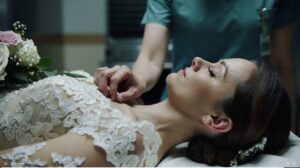
The bride moved.
She took a deep breath — suddenly, as if she had just surfaced from underwater.
Her fingers clenched.
Her eyes slowly opened.
The attendant froze in front of the screen.
A few minutes later, the doctor entered the room.
He wasn’t alone.
The groom was with him.
On the recording, the attendant could hear the doctor saying:
— Everything is fine. The dose was calculated precisely. Officially, it’s clinical death. The documents have already been prepared.
The groom nervously looked around.
— Hurry. We mustn’t be seen.
They helped the young woman stand up.
She was weak, but conscious.
They led her out through a service exit.
The attendant sat completely motionless, barely blinking.
Now she understood everything.
There had been no accidental poisoning.
The bride had been placed into a deep medically induced coma. Her pulse had been slowed until it was almost impossible to detect.
To a superficial examination, she appeared dead.
But why?
A few days before the wedding, the bride had taken out a large life insurance policy. In the event of her death, the money would go to her husband.
But there was something even more important.
The young woman owned a share in her father’s business. As long as she was officially alive, transactions could not be completed without her signature.
After her official death, control would pass to a person she had designated — her fiancé.
The plan was twofold: collect the insurance payout and transfer control of the assets.
After that, the “body” was supposed to be cremated without any additional examinations.
According to the recording, the bride knew about the plan.
She had agreed to disappear so she could start a new life abroad and escape her family’s pressure.
But they had failed to account for one thing — the morgue attendant who refused to believe the words, “You imagined it.”
She saved a copy of the recording.
And this time, she entered the doctor’s office — not alone.