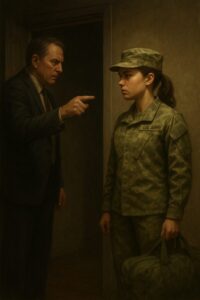
At nineteen I was expecting a child. My father looked right through me and said, “You made your bed. Lie in it,” and the door slammed behind him.
At nineteen I was expecting a child. My father looked right through me and said, “You made your bed. Lie in it,” and the door slammed behind him. The November air cut into my lungs, my breath drifting like scraps of white paper. I had a duffel, a coat that wouldn’t close, and a small life growing inside me. Through the kitchen window, my mother cried but didn’t come; my brother folded his arms and smirked as if he had won. I stepped off that porch and never looked back. In our Midwestern town image was everything. My father, a church deacon, wore Sunday clothes like armor, quoted verses like law, and when trouble touched our house, his rules became weapons. I learned fast how empty a polished sentence could feel when used to push someone away. Survival meant double shifts, cleaning offices at night, busing tables by day, renting a peeling studio where the sink dripped into a pan and the heater moaned more than it worked. I slept beneath thrifted quilts, using my own warmth to keep my baby safe. Every flutter in my belly felt like a promise; this was no longer just my life—it was ours. One cold evening before Christmas my borrowed car died and I cried on a bus-stop bench until a woman in her sixties sat beside me with a warm thermos and said, “Honey, God never wastes pain.” I held those words in my pocket, imagining shame transformed into fuel. I circled night classes in a community college catalog, chased grants and loans, signed up for the Reserve Officer Candidate program for structure, told myself to make a plan, follow it, don’t stop. My daughter Emily arrived in a small hospital room, the bracelet still pinching my wrist as I strapped her into a cheap stroller and marched to the neighbor who watched her while I worked breakfast shifts. Mornings smelled of burnt coffee and baby powder. Classes glowed under fluorescent lights, public speaking terrified me, ROC trained me to move when I was exhausted. At the diner, Walt, a retired gunnery sergeant, slid folded notes across the counter—push-up ladders, blister tape tricks, how to lace boots right—calling every woman “Ma’am,” and somehow the respect stuck. Ruth Silverhair brought casseroles and no questions, teaching me to lift my chin so it didn’t invite pity. A storefront church between a laundromat and a payday-loan store became a room that smelled of reheated coffee and hope. Money lived at the edges; when the gas bill arrived with a red stamp, I sold plasma twice to keep the lights on, stretched one rotisserie chicken across three dinners, sewed buttons with dental floss, read about resilience and scribbled notes in a spiral notebook. In the library, where the copier ate nickels, I wrote my officer accession essay and hit submit with shaking hands. The acceptance letter came in late spring; I held it to my chest, crying a quiet cry that meant a line had turned into a road. Training chewed me up and rebuilt me; I learned azimuths and contour lines, how to count my heartbeats and call them steady, how to make a bunk with corners sharp enough to cut the dark. I missed Emily’s first steps for land navigation, lost daycare over a late signature, earned it back with apologies and warm soup. When I commissioned, the uniform sat on my shoulders like a promise, the new bar balancing life’s math for a moment, Emily clapping in a thrift-store blue dress. I sent a photo to my mother: We’re safe. We’re okay. Not to my father; pride was still tender. The military became my plank, teaching me to move people and supplies with care, brief colonels without shaking, turn hurt into an engine. Years passed; Emily collected library cards, taped them into collages, wrote about
life in college, learning to notice people. One December the phone rang: my mother said my father was ill. I wrote one word on a list: family. I called Emily: “Do you want them here?” she asked. “I want a beginning,” I said. Morning light was pale, Albert, our gatekeeper, polished brass and set poinsettias. My mother stepped out with a scarf from another life, my brother Mark stood like a man chasing our father’s nod, and my father looked smaller than I remembered. He climbed out, cleared his throat: “General,” he said. “Thank you for coming,” I replied. Inside, tree lights blinked steadily, my life gathered in one room—Walt with cookies, a chaplain who became a friend, midshipmen with canned goods, neighbors knowing small gestures matter. My father admitted he had been cruel, thought he was protecting, was wrong. Forgiveness was not a switch, but a practice. We ate, laughed, told old stories, named fear and silence, Emily floating through with envelopes: “Truth first, tenderness close behind.” When they left, the sky turned pink, the road looked new, my father let go of something heavy. In the weeks after, the town watched cautiously, coffee replaced church, casseroles replaced sermons, small acts multiplied. We framed Emily’s collage, our moments under it, the child’s handwriting noting that family is who shows up with glue. I set up a fund for the storefront church, training became community logistics, real power standing for people, not over them. Christmas came with simple rules: one note to each parent, “Bring a true story, bring a coat.” Emily folded them like a truce. We told truths, laughed, admitted fear, and practiced family with small, safe conversations. We didn’t pretend the ledger balanced; we set the table anyway, sang off-key, and distance unwound in ordinary ways. My father appeared more often, volunteering at pantry pick-ups, learning usefulness softens hearts. Illness humbled him more than sermons. Emily grew competent, curious, and kind. On my fiftieth birthday he asked to plant a magnolia for others to sit under; we dug together, putting hope in the ground. Some nights the porch light still comes to mind, healing making space for more than one truth. Years later in uniform, I watched the magnolia wide and dignified, neighbors noting the child’s life becoming her own command. Ordinary noise filled our house—dishes, laughter, voices—my father stayed long enough to feel repair. We planted another magnolia, told soft stories half crying, half laughing. I tell this not to parade hurt, but because a daughter cast out built a life, and the man who sent her away had to face who she became. Justice looked like systems that protect instead of punish: food shelves, buddy checks, scholarships, chairs at a table for hard truths. Don’t let a slammed door be the final scene; show up, set plates, bring tea. The kitchen, the yard, the shade: Emily arrives with cinnamon rolls, the magnolia throws shade, the pantry flows with the seasons, a bus-stop thermos still changes the shape of the town. Twenty years after the porch, my father stood at our gate, Albert asking, “Are you here to see General Morgan?” He was, and when he met my eyes he met a room full of witnesses and a life rebuilt, offering words that tasted like warm bread: “I was wrong.” We didn’t erase the past, we learned to set the plates with care.