Just before I walked down the aisle, my mom slipped a folded note into my hand. “Pretend you’ve fallen. Now,” it read. I didn’t understand, but something in her eyes scared me. Halfway to the altar, I stumbled—on purpose—and fell to the floor. “She twisted her ankle!” my mom shouted. “Stop the wedding! Call an ambulance!” When the paramedics arrived, what they said next shocked me.
by newsmondeanimal ·
My mother, Linda, quietly entered the room. Usually calm and elegant, today she looked unbelievably refined in her silver jacket. But something was wrong. Her eyes shone with a worry I had never seen before. Weakness. I took it for nerves—the kind any mother feels before giving her daughter away.
I glanced at the long golden clock shelf; the hands marked the last seconds of my unmarried life. My heart raced—not from fear, but from anticipation. There he was, the symbol of my lifelong dream.
But my mother said nothing. No compliment, no whispered advice. Instead, she silently approached me and handed me a small crumpled scrap of paper. Her eyes—wide, frightened—were the only explanation.
Confused, I unfolded it. It was a torn page from the ceremony program. In trembling handwriting, it read:
“Pretend you’re falling. Now.”
Everything inside me froze. My blood went cold. Thousands of questions flashed through my mind. Had she lost her mind? Did she want to ruin everything? This was madness.
The wedding march was already playing outside. The doors opened. The time had come.
The only thing that made me act was the unshakable trust I had always had in her. I didn’t understand, but her fear was real. And it scared me more than her command.
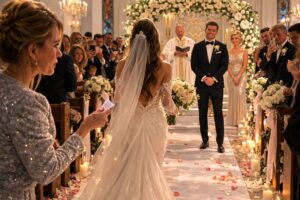
I stepped onto the central aisle. Crystal chandeliers lit the faces turned toward me. At the altar, Tom smiled—radiant, warm, perfect.
I had walked halfway down.
Each step tore me between my love for him and my mother’s incomprehensible plea. My breathing grew heavy. I remembered that brides often faint from excitement. A fall would not raise suspicion.
So I stepped to the side, lost my balance, and fell in the middle of the luxurious aisle—so dramatically that the air seemed to gasp in the hall.
The pain wasn’t physical. It was the realization that I had just destroyed my own wedding—my dream—for a reason I didn’t understand.
The music stopped. Guests held their breath. My mother rushed to me—with such precision and horror that it seemed unreal.
“She twisted her ankle!” she cried. “Stop the ceremony! Call an ambulance!”
Tom and his mother Victoria ran to me—their faces distorted not by worry, but by calculated panic. Not the kind born of love, but the kind that comes when a plan unravels.
I felt nauseous.
The ambulance arrived almost instantly. Amid the chaos, I saw Victoria grasp my mother’s hand.
“You can’t take her,” she whispered. “We have a family clinic—the best in the state. They’ll take care of everything.”
Clinic.
That word changed everything. Something was terribly, disgustingly wrong.
My mother fought with a force I had never seen—not gentle, but fierce. She wasn’t protecting my ankle. She was protecting me.
Within minutes, I was being carried to the ambulance. My dress ruined. My mother had jumped ahead before the doors closed. Through the window, I saw Tom and Victoria on the hotel steps, their faces twisted with anger and helplessness.
It was never about an injured ankle, I realized.
And when the sirens wailed, taking us away from the wedding—and the trap.
Only once we were alone could I voice the question burning inside:
“Why? Mom, why did you do this? You ruined everything.”
She took my hand, her fingers trembling, her voice soft, but her eyes firm.
“I didn’t ruin your wedding, darling,” she whispered. “I saved you from a psychiatric facility.”
Her words hit me like a punch.
She continued in a trembling voice, recounting a conversation she had overheard—Tom and Victoria, hiding, thinking no one could hear them.
“The wedding was the final step,” she said. “They planned to transfer your property to Tom—and then his private psychiatric hospital would declare you incapacitated. They wanted to lock you up, Emily. Forever.”
The world shifted. My heart tore between disbelief and horror.
Tom’s warmth, his promises, his care—it had all been a mask. A tool. Our entire connection had been orchestrated to take my wealth and remove me from my own life.
I didn’t cry. Not yet. Instead, something inside me hardened.
“What now?” I asked.
My mother already knew. She called her lawyer, Arthur Vance, her voice clear, controlled, eerily calm.
“Arthur, code red. Freeze all of Emily’s accounts. Cancel today’s documents immediately—medical necessity and potential harm.”
This wasn’t just stopping a wedding. It was legally voiding it. Tom’s family was immediately under scrutiny.
Later, in the hospital, when the doctors confirmed that I only had a minor sprain—and that my property was protected—I looked at my mother. She sat by my bed: exhausted, yet renewed, unbreakable.
“I thought today would be my wedding,” I whispered, tears streaming. “But you saved me.”
She squeezed my hand.
“I would burn the whole world before letting anyone lock you in a cage.”
And then I understood the cruel truth:
I was never the prize. I was the target.
My mother was not just a parent—she was my shield.
I thought I was walking toward love.
But because of her, I found something far more valuable.
My freedom.