“The prosecutor mocked the silent woman in the courtroom — until her silence revealed the truth that destroyed his career…”
The courtroom was already restless when Anna Novak was brought to the defendant’s stand.
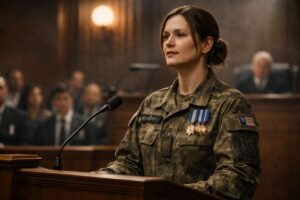
She was short, dressed simply; her dark jacket showed obvious wear at the cuffs. No escort. No legal theatrics.
Just one woman, standing alone before the state, accused of pretending to be a soldier and illegally wearing a national medal for bravery.
Prosecutor Daniel Kruger didn’t waste any time setting the tone.
“Your Honor,” he said with a condescending smile, pacing slowly across the room, “this case is painfully simple. The defendant is not a soldier.”
Not an officer. At best, a fantasist who bought a fake medal at a flea market and decided to live out a childhood dream.
A quiet laugh rippled through the courtroom. Kruger lifted a small velvet box and theatrically held it in the air.
“So-called National Medal ‘For Merits in Defense,’” he sneered. “A clear forgery.”
Anna Novak didn’t react. She didn’t look offended, scared, or even tired. She stood straight, hands at her sides, eyes forward. Not defiantly, but with discipline.
This silence caught the attention of Judge Robert Hale — a man with gray hair, a sharp gaze, and a stern posture hinting at a military past.
As a former colonel before becoming a judge, Hale had seen fear, arrogance, and guilt in every possible form.
What he was seeing now troubled him more than any outburst of emotion.
Kruger took her silence for weakness.
“See, Your Honor,” he continued confidently, “real heroes don’t hide. They don’t walk around secretly wearing medals that aren’t theirs. And they certainly don’t refuse to provide any explanation.”
Yet Anna said nothing.
Judge Hale leaned forward slightly.
“Ms. Novak, you may speak in your defense.”
She met his gaze for a brief moment.
“I understand, Your Honor.”
And… nothing more.
The prosecutor rolled his eyes, clearly satisfied. The judge made a note, and his unease quietly grew.
Then, without warning, a dry sound cut through the courtroom.
A security guard at the aisle staggered, clutched his chest, and collapsed face-first onto the marble floor. Chaos erupted.
Someone screamed. Someone called for help. A court officer froze, unsure what to do.
Before anyone could react, Anna Novak moved.
Within seconds, she leapt over the railing and knelt beside the fallen guard. Her calm voice cut through the noise like a command on a battlefield.
“Clear the space. Now.”
“You, call emergency services.”
“You, bring a defibrillator.”
Her hands were steady as she checked the man’s airway and pulse.
She began precise, methodical chest compressions: perfect depth, perfect rhythm.
When the defibrillator was brought, she activated it without hesitation, giving directions no one dared question.
Judge Hale slowly rose, his heart racing. This was not instinct. This was training.
When the medics rushed in and took control, the guard gasped for air — he was alive.
The courtroom fell silent.
Judge Hale looked at Anna Novak as if seeing her for the first time.
And the question echoed in his mind, while the medal box still lay open on the prosecutor’s table:
Who is this woman… and why has she never defended herself?
The courtroom did not return to normal. Conversations turned into whispers.
Judge Hale called a recess — not the one anyone expected.
“The session is suspended,” he said firmly, “pending review of certain matters.”
“Your Honor,” Kruger began, “with all due respect, this medical incident doesn’t change the facts—”
“It changes my concern,” Hale cut him off sharply. “I have worked for decades with soldiers, doctors, and officers. What I just witnessed was not amateur assistance. It was a combat response.”
Later, behind closed doors, Judge Hale made a call through old secure channels.
The name check came back: Anna Novak. No rank. No assumptions.
The response took longer than usual. When it came, everything changed.
Returning to the courtroom, Hale ordered everyone to remain present.
“Mr. Kruger,” the judge said calmly, “you claimed the medal was fake. What was your basis?”
“Visual inconsistencies. Improper engraving. No record.”
Hale nodded.
“Then this may interest you.”
“This medal is genuine. It was officially awarded posthumously to Captain Marco Novak, who died fifteen years ago during a covert operation in Afghanistan.”
A murmur ran through the courtroom.
“One of the soldiers he saved that day was his daughter.”
The silence became absolute.
“Anna Novak joined the service at eighteen. Later, she received a commission and was assigned to the Special Operations Group 601 of the Czech Armed Forces. Her service includes multiple overseas deployments, awards for close combat operations, and advanced tactical medical certification.”
The prosecutor’s face turned pale.
“She was not pretending to be an officer. She was an officer. She quietly left the service three years ago.”
“Why keep silent?” Kruger spat.
“Because I was ordered to,” Anna replied calmly. “I follow orders, even when inconvenient.”
Judge Hale immediately dismissed all charges.
But the case did not end there.
The prosecutor’s conduct was deemed unprofessional. Within weeks, his career unraveled.
Anna Novak refused interviews and public recognition. The only thing she did was anonymously pay for full rehabilitation of the guard she saved.
No press releases. No medal ceremonies. Just silence.
Later, Judge Hale wrote a phrase that would be quoted for years:
“A court should never punish restraint merely because it is mistaken for weakness.”
Anna returned to civilian life. She trained first responders and paramedics. She never spoke of her past.
When asked why she had never spoken up, she said:
“Because the truth was never at risk. Only people’s assumptions were.”
Some people don’t need recognition to be real.
They only need a moment to act.
And when that moment comes, silence speaks louder than any defense.