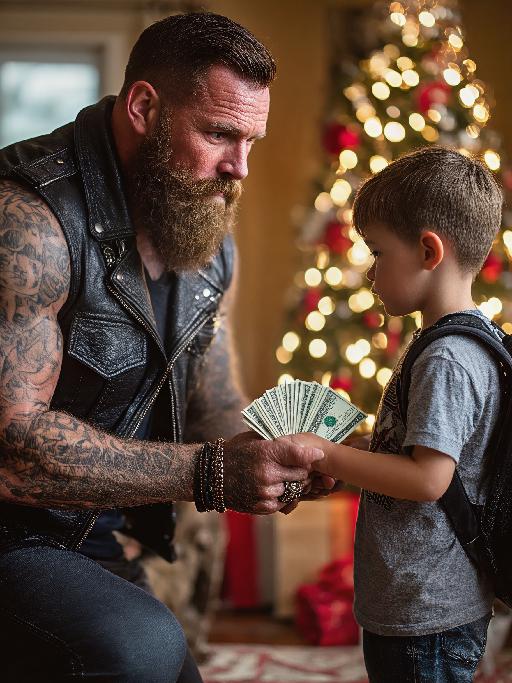
A homeless boy saved a biker’s daughter and refused their money — so the Hells Angels showed up with 200 motorcycles to deliver a different kind of payment.
The Boy in the Ghost Car and the King of Chrome
The giant in leather standing before Jordan Mitchell wasn’t asking anymore. He was insisting. Behind him, nearly two hundred Hells Angels’ bikes filled the narrow street, chrome and leather stretching as far as Jordan could see. The engines idled with a low, controlled power that rattled windowpanes and vibrated deep within the chest. It was the kind of sound that made people on the East Side of Silver Valley bolt their doors without looking out. It was the kind of sound that meant whatever was happening was already beyond their control. Three days ago, Jordan Mitchell had done the impossible. And now, the impossible had come looking for him.
Hidden behind the crumbling brick walls of what was once Morrison’s Grocery sat a 1987 Chevy Caprice. It was grey, covered in a coat of dull primer. Rust bled around the wheel wells like an open wound. All four tires were so flat the rims seemed to kiss the pavement. The windows were opaque, blurred by years of grime and dust, impenetrable to the eyes of anyone passing by. Most people assumed it was an abandoned carcass, another dead thing left behind when the store closed and the neighborhood followed it into decay. No one looked closely enough to notice the thin wool blanket neatly spread across the back seat. No one noticed the plastic jug tucked against the passenger door. No one noticed the faint indentation where a body slept curled up every night, saving heat, saving space, saving breath. No one imagined that a fifteen-year-old boy called this wreckage “home.”
Silver Valley was a town that survived by choosing not to see certain things. The East Side was full of them. Cracked sidewalks. Half-collapsed trailers. Boarded-up windows that would never be fixed because no one important lived behind them. The invisible people learned to survive there, learning which streets to avoid and which sounds signaled danger. Jordan Mitchell had realized early on that survival wasn’t about being strong or fast. It was about becoming forgetful. Moving in a way that made eyes slide right past you. Never giving anyone a reason to ask questions.
He woke up every morning the same way. Motionless. Silent. Listening. He listened for footsteps first. Voices. The hum of engines that lingered too long nearby. Only when he was certain the world had moved on without him did he move. Jordan would slowly unfold from the back seat, his large frame stiff after another night curled around his backpack. The backpack never left his body. Not when he slept. Not when he washed at the spigot behind the building. It was his entire life compressed into fabric and zippers. Inside were two changes of clothes, a toothbrush, and seventeen dollars in small bills earned from washing semi-truck windshields. And at the very bottom, wrapped in a faded t-shirt, was a photograph.
He moved through Silver Valley like a ghost. Head down. Shoulders slumped. Clothes just clean enough to avoid suspicion. Looking homeless invited questions. Questions invited reports. Reports invited the System. And Jordan would rather face death than go back into the System. In the afternoons, he went to the library. It was the only place he could exist for hours without being bothered. He taught himself algebra from old textbooks because learning was the only thing that made the world quiet. At night, he would hold the photo. A younger version of himself stared back, grinning with a golden retriever named Buddy. His grandmother stood behind him, caught mid-laugh. The photo was six years old, from a time when “home” meant walls, warmth, and someone waiting for him. Before the foster homes. Before the scars. He had no idea that, in seventy-two hours, everything he believed about survival was about to be pulverized by a single moment of instinct.
Victor Cain had been the President of the Silver Valley Hells Angels chapter for nine years. He was six-foot-four, built like a freight train, and covered in scars and ink earned over decades of hard living. When Victor walked into a room, conversations stopped. Not because people expected violence, but because he carried a gravity that demanded respect. In the clubhouse, the brotherhood functioned with military structure. They weren’t just outlaws; they were mechanics, veterans, and welders. Men who found in each other the loyalty the outside world never offered. They raised money for veterans and escorted abuse survivors to court when they were too terrified to walk in alone. And Victor Cain protected his daughter like she was the last sacred thing left in a world that had already taken too much.
Autumn Cain was seven years old. She had untamed curls and fearless energy. She had inherited her mother’s smile and her father’s stubbornness. Victor’s wife, Caroline, had died three years ago. Cancer. Fast. Brutal. Relentless. Victor had money and connections, but nothing had been enough. Autumn became his anchor. The reason he held on. People crossed the street when they saw the patches on their vests. Shopkeepers tensed up when the bikes pulled in. What they didn’t see, beyond the leather and the roar, was a brotherhood that understood family—not always by blood, but by choice.