They thought she was just another quiet new girl—an easy, dark-skinned target with no one to back her up.
The Silent Storm
The bullies made the first move without realizing they weren’t just hitting a girl—they were triggering a storm.
The slap echoed through the hallway, and what happened next stunned everyone. The moment she stood back up, the power hierarchy at Westbrook High shifted forever.
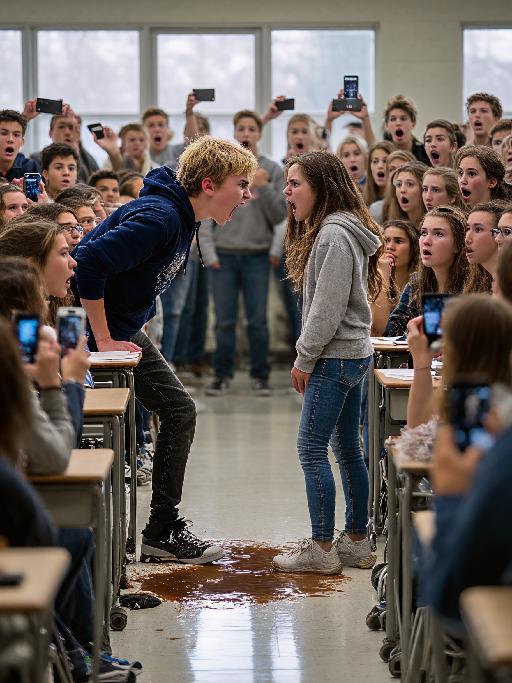
They thought she was just another quiet “new girl.” Amara Lewis had transferred in mid-October—a timing that made people assume she wouldn’t matter. She was dark-skinned, tall but slender, and wore her hair in a simple bun. She spoke softly, sat in the back row, and ate lunch alone.
No friends.
No loud opinions.
No visible protection.
To girls like Madison Keller and her clique, that made Amara an easy target. It started small—whispers when Amara walked by, snide remarks about her clothes, jokes about how she “didn’t fit the vibe.” The teachers never noticed. Or they chose not to.
Amara didn’t snap back. She kept her head down, took notes, and vanished the second the final bell rang. Madison took that silence for weakness.
The Breaking Point
The hallway outside the science wing was packed that Friday afternoon. Lockers were slamming; voices were echoing. Amara was heading for the exit when Madison stepped directly into her path.
“Watch where you’re going,” Madison said loudly, though Amara hadn’t even touched her.
“Excuse me,” Amara replied calmly, trying to step around.
Madison laughed. “You guys hear that? The statue speaks.” The group closed in. Someone shoved Amara’s shoulder. Another girl snatched her notebook, letting it hit the floor with a thud.
Amara reached down to pick it up. That’s when Madison slapped her. The sound cracked through the hall like a gunshot. The chatter stopped. Heads turned. Amara froze, her cheek burning, her notebook clutched halfway in her hand. For a split second, everyone expected tears. Or a scream. Or nothing at all.
Instead, Amara stood up. Slowly.
She squared her shoulders, locked eyes with Madison, and spoke with a clarity that carried to the end of the hall.
“Do not touch me again.” Madison sneered. “Or what?”
Amara didn’t raise her voice. She didn’t make a threat. But something in her expression shifted—focused, grounded, unshakable.
“You’ve already crossed the line,” Amara said. “And now, there are witnesses.”
At that exact moment, the Assistant Principal, Mr. Reynolds, appeared at the end of the hall, drawn by the sudden silence. The crowd parted. Madison flashed a smug, practiced smile, confident as always.
But the power had already shifted. Not because Amara had fought back, but because she hadn’t broken. From that moment on, the whole school would learn that silence wasn’t a surrender—it was restraint.
The Fallout
The office smelled like old carpet and stale coffee. Amara sat perfectly upright, hands folded in her lap. Madison sat across from her, arms crossed, rolling her eyes as if the whole thing were a joke.
Mr. Reynolds sighed. “Let’s hear both sides.”
Madison went first, spinning a story with ease—claiming Amara shoved her, disrespected her, “got in her face.” She denied the slap without blinking.
Amara waited. When it was her turn, she told the truth. Calm. Clear. No exaggeration. No tears. She detailed the weeks of harassment, the notebook, the slap, and the names of the students watching.
Reynolds hesitated, then glanced at the security monitor on his desk. That was the moment Madison’s confidence cracked. The footage wasn’t perfect, but it was clear enough. The slap. The circle. The silence.
Madison was suspended for three days. It was the first time she had ever faced a real consequence.
The Shift
On Monday, the school felt different. Some kids avoided Amara. Others stared. A few whispered apologies they’d never had the guts to say before.
Amara didn’t celebrate. She didn’t brag. She just went back to her routine.
What they didn’t know was that Amara had moved three times in four years. Different states. Different schools. Same patterns. She had learned early on that reacting with emotion only fed people like Madison. Her mother had taught her something else:
“Document everything. Your voice matters most when you stay level-headed.”
At home, Amara kept a journal filled with dates, names, and incidents. She never wanted to use it. Until now.
By spring, Amara Lewis was no longer invisible. She joined the Debate Team. She spoke with precision, logic, and command. Her team started winning. Madison watched from the sidelines, furious but powerless.
The Legacy
The final turning point came during a school assembly on student conduct. The Principal asked if anyone wanted to share their experience. The auditorium went dead silent.
Amara stood up.
She walked to the mic, her heart steady. She didn’t name names. She didn’t accuse. She spoke about what it’s like to be judged, targeted, and underestimated. She spoke about how silence is often mistaken for weakness, and how accountability changes a culture.
The applause wasn’t a roar—it was a sincere, heavy acknowledgment.
After that, the “rules” at Westbrook changed. Teachers intervened earlier. Counselors followed up. The bullying didn’t disappear, but it no longer thrived in the shadows.
Madison transferred schools before graduation. On the last day of senior year, a classmate named Ethan walked with Amara toward the parking lot.
“You changed this place,” he said.
Amara shook her head. “I didn’t change it. I just stood still long enough for the truth to show itself.”
She stepped out into the sunlight, ready for whatever came next.
THE END