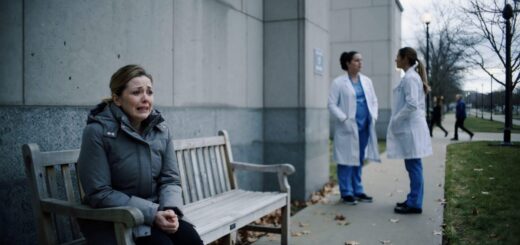
Every day, a 7-year-old girl tucked her lunch away instead of eating it. Curious, her teacher followed her during break— and what she saw behind the school forced her to make an emergency call.
The lunch bell echoed across Oakwood Elementary as my second-graders filed back into the classroom. I counted quickly—nineteen, twenty, twenty-one. One missing.
Lily Parker. Again.
This was the third time she hadn’t returned from lunch, and she hadn’t been in the library either. After asking my classroom helper to start silent reading, I headed down the hall and checked the usual places. No Lily. Not until I stepped outside and saw a flash of purple—her backpack disappearing around the building toward the wooded area behind the school.
My stomach tightened. Students weren’t allowed back there.
I followed at a distance, watching as Lily walked down a narrow trail and stopped by a large oak. She opened her backpack and pulled out her untouched lunch again. She wasn’t eating it—she was taking it somewhere.
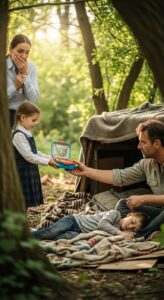
The trail ended in a small clearing near the creek. There, hidden under a patchwork of tarps and salvaged boards, stood a makeshift shelter. A man sat on an overturned crate, and beside him slept a feverish little boy.
“Daddy? I brought lunch,” Lily said softly.
The man—exhausted, unshaven, and clearly struggling—looked up. “Hey, pumpkin. Noah’s still running a fever.”
That was when I stepped into view.
“I’m Rebecca Collins,” I said carefully. “Lily’s teacher.”
The situation became painfully clear: after the death of his wife, Daniel Parker had lost their home, their insurance, and nearly everything else. He was trying to keep his children safe while living outdoors, and Lily had been secretly giving up her meals to help them.
But Noah wasn’t just sick—he was dangerously ill.
When I touched the boy’s forehead, the heat radiating from his skin confirmed it. “He needs a doctor,” I said. Daniel panicked, terrified that Child Services would take his kids if anyone found out. But Noah’s life was at risk, and that left no choice.
I called 911.
At the hospital, doctors diagnosed severe pneumonia. Social services soon appeared, asking hard questions and hinting at foster care. I found myself standing between the Parkers and a system that
could easily separate them.
Back at school, my principal reprimanded me, removed Lily from my class, and warned me that my job was at risk. But after seeing what this family was living through, “protocol” felt irrelevant.
When CPS considered placing the children in emergency foster care, I offered something I never expected to say out loud:
“They can stay with me.”
It was unconventional, risky, and the opposite of what the school wanted. But it kept the family together. Over the next months, Daniel found work, public assistance helped stabilize things, and eventually a legal settlement gave him the chance to rebuild properly.
Six months later, I watched Daniel and the kids move into a modest, warm home on Oak Lane—safe, clean, and fully theirs. Noah was healthy, Lily was thriving, and Daniel had rediscovered his footing as a father.
As we stood in their new driveway, Lily declared, “It already feels like home. Because we’re all here.”
She was right.
I had set out that day simply trying to find a missing student. I didn’t know that following a purple backpack into the woods would change all of our lives—saving Noah, keeping a family from breaking apart, and gently pulling me out of my own grief into something like hope again.