The Day Even the Devil Bowed His Head: The Secret Identity of the Old Man Who Humiliated the Prison Kingpin.
If you came here from our Facebook page to find out what happened to “The Russian” and who that old man really was, you’re in the right place. Below is the full, uncensored story with an ending that no one saw coming. Get ready, because what you’re about to read will change the way you judge people forever.
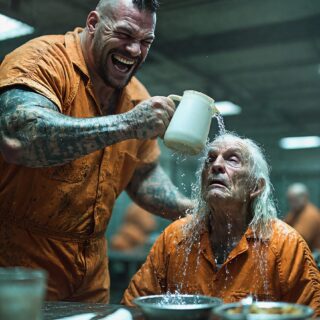
The cafeteria at San Quentin State Prison is a place where the air is thick. It smells of rancid sweat, burnt beans, and above all, fear. But that afternoon, fear had a different taste. It was metallic, like the taste in your mouth when you accidentally bite your tongue.
Ivan “The Russian” Petrov didn’t know that taste. Or at least, he thought he didn’t.
Standing nearly seven feet tall and weighing 265 pounds of pure muscle, he had entered the prison three days earlier with the label of “Alpha Predator.” In his mind, prison wasn’t a punishment—it was a market, and he was there to be the boss. He spent his first 72 hours analyzing the yard. He saw the gangs, the loners, and the weak. But his fatal mistake was confusing silence with weakness.
The Anatomy of a Fatal Error
When “The Russian” set his eyes on the back table, he saw what all rookies see: a decrepit old man. The old man, whom some guards respectfully called “Don Anselmo,” ate with agonizing slowness. His skin was as weathered as an old leather boot, his hair was snow-white, and his hands trembled slightly as he held his plastic spoon.
To the Russian, this was an insult. “How is it possible that this fossil occupies the best table, the one by the window?” he thought. His logic was simple and brutal: might makes right.
He approached. Each step echoed on the concrete floor. The other inmates, who had been there for years, knew how to read the atmosphere better than the weather. “Chino” Lopez, head of the South Wing, stopped eating. The members of The Brotherhood—men who feared neither God nor death—looked down at their plates. No one warned him. In prison, when a newcomer is about to commit “social suicide,” no one stops him. It’s part of the show.
The Russian reached the table and kicked the chair. The crash was the starting pistol for a race into the abyss. “Are you deaf, old man?” he roared, using the voice that used to make debtors tremble in the streets.
Don Anselmo didn’t flinch. He continued chewing a piece of bread, his gaze lost in the distance, as if the giant blocking his light was no more important than an annoying fly. This indifference shattered the Russian’s ego. He shoved him. The food tray flew. Soup stained the old man’s clean uniform.
And then, time stopped.
The Tattoo That Froze the Heart of the Prison
The old man rose slowly. But that’s where the story takes a dark turn. It wasn’t just the way he stood; it was what he revealed when he pushed up his sleeve.
On his left forearm, the ink remained black and intense, as if it had been injected yesterday. It wasn’t a skull, a woman, or the typical prison teardrops. It was a complex geometric symbol: a two-headed snake devouring an hourglass.
The Russian didn’t know what it meant. But the rest of the cafeteria did. That symbol belonged to “The Timeless.” An elite 1980s organization that didn’t deal in petty theft. They were “Cleaners.” The ghosts cartels hired when they needed someone to disappear without a trace, without a sound, and without witnesses.
Judging by the two heads on the snake, Don Anselmo wasn’t just a soldier. He was a founder.
The Captain of the Guards, watching from the control tower, turned pale. He grabbed his radio and gave an order rarely heard in a maximum-security prison: “Hold your fire! I repeat, do not intervene. If you touch the old man, we’ll all be dead before dawn.”
The Russian, unaware he was standing in front of Death itself, raised his fist for the final blow. “I’m going to teach you respect, you old piece of junk!” he screamed. He swung—a missile of flesh and bone aimed straight at Anselmo’s face.
What happened next was so fast that many thought it was a trick of the light.
The Dance of Pain
Anselmo didn’t run. He didn’t step back. He simply tilted his neck one inch to the right. The Russian’s fist whistled past his ear, hitting nothing but air. Before the giant could regain his balance, the old man’s “trembling” hand became a blur.
With a swift, surgical strike, Anselmo hit the giant’s throat with the edge of his hand. It wasn’t a power punch; it was precise. The Russian began to choke. His airway momentarily collapsed. He clutched his neck, eyes wide, desperately gasping for air.
But Anselmo wasn’t finished. With chilling calm, he grabbed the Russian’s right hand—the one that had tried to strike him—and pressed his thumb into a specific pressure point on the wrist. The 265-pound giant dropped to his knees. He tried to scream, but only an agonizing hiss came out. The pain was so intense it felt like a high-voltage cable had been plugged directly into his nervous system.
The cafeteria remained in total silence. All you could hear was the Russian’s ragged breathing and the soft sound of Anselmo’s shoes as he stepped around him. The old man leaned down until he was face-to-face with the kneeling thug. His eyes, which had seemed tired, now burned with predatory intensity.
“Son,” Anselmo whispered, his voice raspy but clear. “In here, size doesn’t matter. History matters. And you… you have no history.”
The True Sentence
Most movies end there: the hero wins, the villain loses. Но реальная жизнь в тюрьме гораздо сложнее.
The Russian expected to be killed that night. He huddled in his cell, shaking, waiting for Anselmo’s men to finish the job. But no one came. The next morning, he entered the cafeteria with his head down. He walked toward the back table. He stopped six feet away.
Anselmo looked up. “Sit,” the old man said. The Russian obeyed.
“I didn’t kill you yesterday,” Anselmo said, breaking a piece of bread and offering it to the giant, “because a dead man learns nothing. And you, you need to learn. From today on, you are my eyes and my ears. As long as you are under my wing, no one touches you. But if you ever lift a hand against someone weaker than you again… you’ll wish I had killed you yesterday.”
The Unexpected Turn
Three years have passed since that day. If you visit the prison today, you’ll see something curious. At the back table, Don Anselmo is still there, reading the paper. And beside him, always, like a faithful guardian, stands the Russian.
He’s not the thug who kicked chairs anymore. He’s thinner, quieter. He learned to read thanks to the books Anselmo lends him. He protects the new, terrified inmates, stopping others from abusing them.
The man who entered wanting to be the King of the Jungle became the Monk guarding the Temple. Don Anselmo, “The Surgeon” of the past, didn’t use violence to destroy his enemy. He used a just and necessary violence to transform him.
The Moral: Never judge a book by its cover, especially not by the age of its pages. Sometimes, the quietest people carry the most violent storms. True strength isn’t about the power of your blow—it’s about having the power to destroy someone and choosing, instead, to teach them how to be human.


