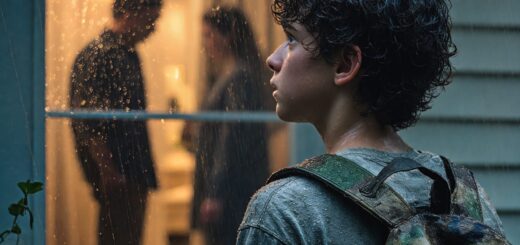
corner of my eye. A bundled shape behind one of the concrete pillars flinched, a jacket pressed tighter around a small frame.
I was already halfway convinced to skip the pharmacy trip when icy pellets of sleet hammered my windshield like a warning. November in Ohio has a way of making decisions for you. I pulled into the third floor of the parking garage, flipping up my collar and keeping my head down. The mission was simple: get cough syrup, get home, get warm.
Something stirred in the corner of my eye. A bundled shape behind one of the concrete pillars flinched, a jacket pressed tighter around a small frame. I told myself to ignore it, to walk on, but then I caught sight of the shoes. The outline. The unmistakable silhouette of a kid who once stayed after class to debate whether gravity was a bend in spacetime or just a cosmic optical illusion.
His eyes snapped open—fear and apology tangled together. He sat up quickly, pulling his backpack to his chest like armor.
“Ms. Carter—please… please don’t tell anyone.”
Air left my lungs in one cold rush. The boy who’d won the regional science fair with a model of gravitational waves was sitting on bare concrete, cheeks windburned, voice trembling.
“Sweetheart,” I said, kneeling in front of him, “why are you here?”
He held my gaze only long enough for it to hurt, then looked away.

“They don’t care when I’m gone,” he murmured. “My dad and my stepmom… they throw parties. Strangers everywhere. Last night I couldn’t even get into my room. Someone was yelling. So I left. I’ve been here three nights.”
There are moments when life shifts on a hinge, and you can feel it turning. I was fifty-three, twenty years into teaching physics, childless except for the countless students who passed through my classroom. I’d accepted the quiet of my home, the soft clatter of a single dish in the sink. But standing in that bleak garage, with winter breathing cold against the walls, something in me clicked into place. Something shaped like a promise.
“Come on,” I told him, offering my hand. “You’re coming with me.”
He resisted—afraid of being trouble, afraid of being seen—but I didn’t let him refuse. Ten minutes later he sat at my kitchen table eating tomato soup and a grilled cheese I’d burned slightly because my hands shook. He devoured the food like warmth itself. After a long shower, he returned pink-cheeked and quiet, the tension drained from his shoulders. He fell asleep on my couch, fingers relaxed against the blanket as though even his body finally believed it was safe.
By morning his pride had crept back in.
“I can go home tonight,” he insisted, trying to sound grown. “It was just a bad weekend.”
“Bad weekends don’t last three nights,” I said. “You’re not going back.”
The weeks that followed were messy the way real life is messy. Courtrooms rarely feel heroic. His father arrived to the hearing smelling of alcohol and outrage, waving his arms like he could bend the truth by force. The stepmother scrolled through her phone between exaggerated sighs. Ethan’s voice shook as he described strangers drifting through the house at 2 a.m., doors he wasn’t allowed to lock, names he learned not to ask. The judge’s jaw tightened. Temporary guardianship—then, half a year later, permanent.
People imagine rescue as thunder and fanfare. In my house, it was quieter: lavender-scented laundry folded neatly on his bed; a bowl of apples on the counter; the dining table buried in scholarship forms, late-night calculations, and half-finished essays. He slept—first in fragments, then in the steady peace of someone who finally believes the night won’t betray him. His grades bounced back like a slingshot released. The spark in his eyes—the one that lit up whenever he said physics was “the language the universe thinks in”—returned in full force.
Sometimes he slipped and called me “Mom.” The word came out small and surprised, as if it had escaped him. He’d blush; I’d sip my tea like nothing happened while my heart quietly rearranged itself to make room.
Senior spring swept him into a whirlwind of competitions, emails from professors who rarely wrote to undergraduates, and thick envelopes with embossed seals. Acceptance letters. Scholarships. Astrophysics.
I cried in the grocery store—right between the lettuce and radishes—when the biggest letter came. A stranger touched my elbow and said, “Good news?” I nodded, unable to explain that the universe felt like it was finally answering a question I didn’t know I’d asked.
At his honors ceremony I wore a dress that had waited years for a celebration. His father and stepmother looked polished for the cameras—habit masquerading as sincerity. When Ethan’s name was called, he stepped to the microphone.
“I wouldn’t be here without one person,” he said. “Not my father. Not my stepmother. The person who saved my life is in the third row.”
His eyes found mine instantly.
“Ms. Carter found me sleeping in a parking garage. She could’ve walked away. She didn’t. She fought for me. She became the mother I never had.”
He came down from the stage, placed the medal around my neck, and whispered, “This belongs to you, Mom.” Behind us, his father reddened with anger; his stepmother drifted toward the exit. The room erupted in applause that washed over us like warm rain.
And then—“I’m starting a foundation,” he announced as the applause faded. “For kids who fall through the cracks like I did. And one more thing.” He squeezed my hand. “I changed my last name last month. I’m proud to carry hers.”
The paperwork arrived a week later. My surname typed next to his. I pressed my thumb to the page, laughing unexpectedly in my silent kitchen.
Years move with their own kind of gravity. They pull, whether you’re ready or not. Ethan settled into a dorm stocked with mismatched mugs and dreams he finally believed he deserved. He called every Tuesday from beneath a clearer sky, telling me the stars looked different there, freer somehow. He mailed me a photo of a whiteboard filled with equations and wrote, “Isn’t this beautiful?” like it was a poem I should frame.
He came home for Thanksgiving with new confidence and the same old grin. He brewed my coffee and criticized the inefficiency of my kettle, which I let him do. He slept late. Left textbooks everywhere. We watched a documentary about cosmic background radiation and argued over the narration. When he hugged me goodbye, he held on long enough to rattle loose the ghosts of all the years before.
I still teach high school physics. I still watch for that split second when a student realizes the world runs on rules elegant enough to be loved. Every June, I sit in a gym that smells of carnations and possibility and listen for new last names woven with old ones.
And every night this house—once so painfully quiet—holds echoes that make it feel alive: remembered laughter, the distant rush of a shower, the soft click of a lock I turn knowing someone else has a key.
People sometimes ask if I regret not having children. I tell them the truth: gratitude and grief can share the same seat. The life I thought I’d live closed behind me long ago. Another opened in a cold garage when a boy whispered “Please,” and I answered with the only word that mattered:
“Come.”
Family is sometimes biology.
Sometimes it’s a choice you remake every ordinary day.
And I had no idea my story wasn’t ending—
the universe just had a different equation in mind.